
Mobile phone wireless charger: principle analysis and practical advantages
Abstract
This paper deeply explores the principles and practical advantages of mobile phone wireless chargers. First, the development history of wireless charging technology is introduced, and then its working mechanism based on electromagnetic induction, magnetic resonance and other principles is elaborated in detail, and the key factors affecting charging efficiency are analyzed. Subsequently, from the perspectives of convenience, safety, durability, compatibility, aesthetics, etc., the practical advantages of wireless chargers are comprehensively analyzed, and its limitations are also pointed out. Finally, the future development trend of wireless charging technology is prospected, providing readers with a comprehensive understanding of mobile phone wireless chargers.
I. Introduction
In the era of rapid technological development, mobile phones have become an indispensable part of people’s lives. With the increasing power of mobile phone functions, their battery life has also become the focus of users. Although the traditional wired charging method is stable and reliable, the constraints of cables have brought many inconveniences to users. The emergence of mobile phone wireless chargers provides a new way to solve this problem. It gets rid of the entanglement of cables, making the charging process more convenient and free, and has gradually been favored by consumers. So, how does a mobile phone wireless charger work? What practical advantages does it have? This article will discuss this in depth.
- Principle of mobile phone wireless charger
(I) Principle of electromagnetic induction
Mobile phone wireless charging technology mainly relies on the principle of electromagnetic induction. This principle is similar to the working principle of transformers, both of which are based on Faraday’s law of electromagnetic induction. When the magnetic flux passing through a closed circuit changes, an induced electromotive force will be generated in the circuit, thereby forming an induced current.
In the wireless charging system, there are two key components: the transmitter (charger) and the receiver (charged device, such as a mobile phone). The transmitter has a built-in transmitting coil. When current passes through the transmitting coil, an alternating magnetic field will be generated around the coil. The receiving end has a built-in receiving coil. When the receiving coil is close to the alternating magnetic field generated by the transmitting end, the magnetic field will pass through the receiving coil. According to Faraday’s law of electromagnetic induction, an induced electromotive force will be generated in the receiving coil, and an induced current will eventually be formed. After this induced current is processed by circuits such as rectification and voltage stabilization, it can charge the device battery.
Figuratively speaking, the wireless charging process can be imagined as two adjacent coils having a “conversation”. The transmitting coil “speaks” (sends electromagnetic waves), the receiving coil “hears” (receives electromagnetic waves), and converts the “heard information” (electromagnetic wave energy) into “language” (electrical energy) that it can understand, thereby completing the energy transfer.
(II) Principle of magnetic resonance
In addition to the principle of electromagnetic induction, magnetic resonance is also a way to implement wireless charging technology. Magnetic resonance wireless charging uses the resonance principle to allow a certain distance interval (usually a few centimeters to tens of centimeters) between the transmitting end and the receiving end, and energy is transferred through the resonant magnetic field.
In the magnetic resonance wireless charging system, both the transmitting end and the receiving end contain a resonant circuit, and the two circuits are adjusted to the same resonant frequency. When the resonant circuit of the transmitting end is excited, an alternating magnetic field is generated, which resonates with the resonant circuit of the receiving end. In the resonant state, energy can be efficiently transmitted between the transmitting end and the receiving end. Compared with magnetic induction wireless charging, magnetic resonance wireless charging has the advantages of longer charging distance and higher degree of freedom, and can realize “air charging” and even “simultaneous charging of multiple devices”. However, it also has disadvantages such as complex technology, high cost, relatively low efficiency (especially at long distances), and higher requirements for safety control. At present, magnetic resonance wireless charging technology is still developing and popularizing, and has not yet become mainstream.
(III) Factors affecting charging efficiency
- Induction distance: The smaller the distance, the higher the charging efficiency. Magnetic induction wireless charging is very sensitive to distance. The increase in distance will cause the magnetic field strength to decay rapidly, and the energy transmission efficiency will be greatly reduced. Therefore, when using wireless charging, the device should be kept close to the charger surface as much as possible.
- Induction area (coil alignment): The larger the contact area between the transmitting coil and the receiving coil, the higher the charging efficiency. Coil misalignment will lead to reduced magnetic field coupling efficiency and increased energy loss. Some wireless chargers use a multi-coil design to expand the induction range and reduce the requirements for alignment accuracy.
- Temperature: Increased temperature will reduce charging power, resulting in a decrease in charging efficiency. During wireless charging, both the coil and the circuit will generate heat. Excessive temperature will affect the magnetic conductivity of the coil and may trigger the overheating protection mechanism, reducing the charging power. Therefore, maintaining good heat dissipation is essential to improve the efficiency of wireless charging. Avoid using wireless chargers in high temperature environments and ensure good ventilation around the charger.
III. Practical advantages of mobile phone wireless chargers
(I) Convenience
- Get rid of cable constraints: The traditional wired charging method requires the use of a charging cable to connect the mobile phone to the charger. The entanglement of the cable not only affects the appearance, but also easily causes inconvenience during the charging process. The wireless charger only needs to place the mobile phone on the charging plate to start charging, without plugging and unplugging the data cable, making the charging process more concise and refreshing. For example, when working in the office, you can put the wireless charger on the desk and put the mobile phone on it to charge at any time without worrying about the interference of the cable, making the desktop more tidy and orderly.
- Fragmented time charging: The wireless charging method is more casual, and people can use fragmented time to recharge their mobile phones at any time. When resting in the bedroom, put the mobile phone on the wireless charger before going to bed, and the mobile phone will be fully charged in the morning; when dining in the restaurant, put the mobile phone in the wireless charging area provided by the restaurant, and you can also charge the mobile phone while dining. This convenient charging method makes full use of people’s time and improves the efficiency of life.
(II) Safety
- Avoid the risk of electric shock: Wireless charging avoids the risk of electric shock caused by improper plugging or poor quality data cables. If the traditional wired charging interface is improperly operated or the data cable has quality problems during the plugging and unplugging process, it may cause electric shock accidents. The wireless charger adopts a non-powered contact design. The current is transmitted through the electromagnetic field. There is no direct electrical connection, which greatly reduces the possibility of electric shock. It is especially suitable for people who are more sensitive to electrical safety, such as the elderly and children.
- Multiple protection functions: Wireless chargers have multiple protection functions, such as overcharge and over-discharge protection, metal foreign body detection, etc. The overcharge and over-discharge protection function can prevent the mobile phone battery from being damaged due to overcharging or over-discharging, and extend the battery life. The metal foreign body detection function can detect whether there is a metal foreign body between the charger and the receiving device. Metal objects will generate eddy currents in the alternating magnetic field, causing themselves to heat up. If there is a metal foreign body between the charger and the device, and the charging power is large, the metal foreign body may heat up rapidly, causing safety hazards such as burns, equipment damage, and even fire. When a metal foreign body is detected, the charger will immediately stop supplying power and sound an alarm to ensure safe use.
(III) Durability
- Reduce interface wear: Frequent plugging and unplugging of mobile phone charging cables will cause wear on the mobile phone charging interface. After long-term use, it may cause problems such as loose interfaces and poor contact, affecting the normal use of the mobile phone. Wireless chargers do not need to plug and unplug data cables, which reduces the wear on the mobile phone charging interface, extends the service life of the interface, and reduces the probability that the mobile phone needs to be repaired due to interface problems.
- No leakage of components: The power transmission components of wireless chargers have no leakage, will not be corroded by moisture, oxygen, etc. in the air, and there is no problem of contact wear. In contrast, the charging interface and cable of wired chargers are easily affected by the external environment, such as oxidation and wear, resulting in reduced charging performance. This feature of wireless chargers gives them a clear advantage in durability and can provide users with more stable and reliable charging services.
(IV) Compatibility
- Follow unified standards: In order to promote the popularization and standardization of wireless charging technology, the Wireless Power Consortium (WPC) was established in 2008 and launched the world’s first international wireless charging standard Qi. As long as the device and charger are marked with the Qi logo, even products of different brands can be compatible with each other for charging, breaking the barriers of inconsistent wireless charging standards and poor compatibility in the past. This means that users no longer need to equip different devices with different chargers. Only one Qi wireless charger can charge a variety of devices that support the Qi standard, such as smartphones, wireless headphones, smart watches, etc., greatly improving the convenience of charging.
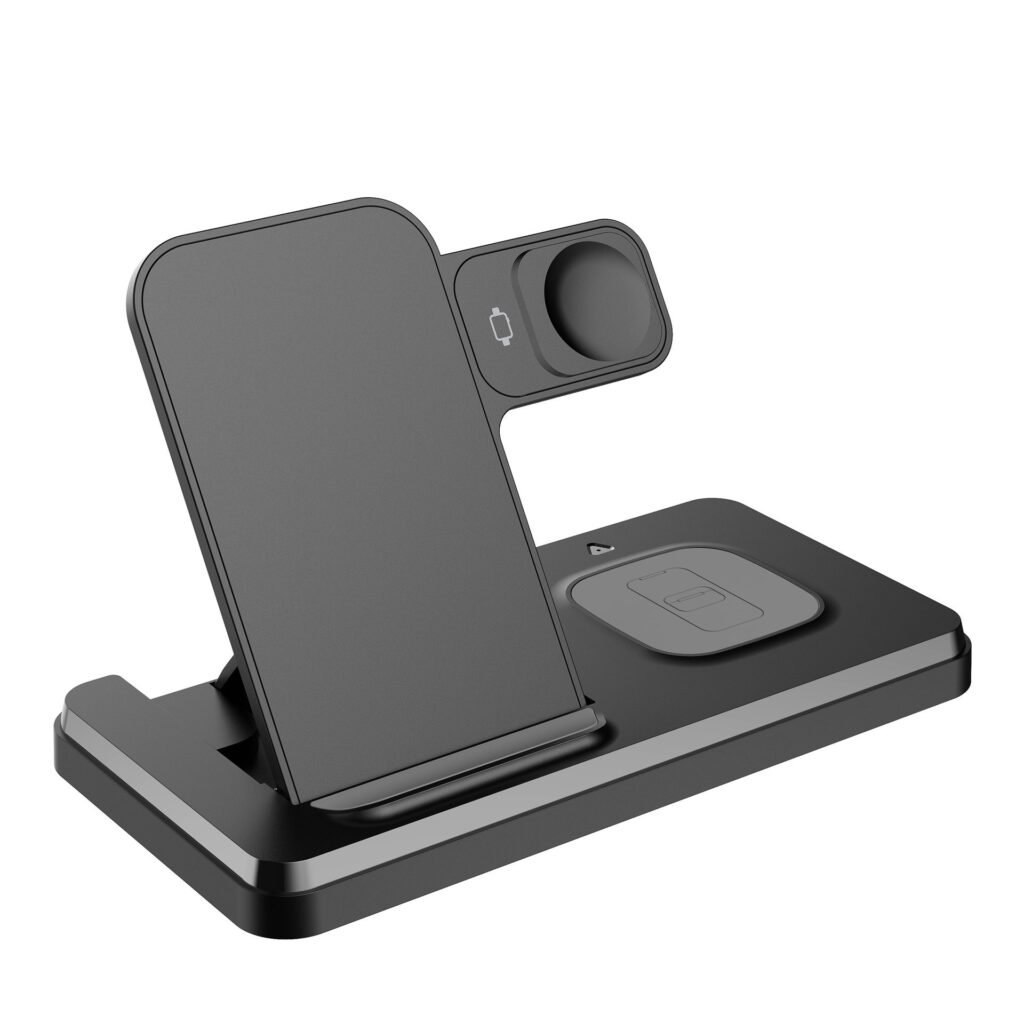
- Multi-device charging: Some wireless chargers support charging multiple devices at the same time, further improving the efficiency of charging. For example, users can put their mobile phones and wireless headphones on a wireless charger that supports multi-device charging at the same time, and recharge two devices at once, meeting the user’s needs for multi-device charging.
(V) Aesthetics
- Simple design: The appearance design of wireless chargers is usually simple, without the entanglement of cables, so that they can better integrate into various home and office environments. Whether it is placed on the coffee table in the living room, the bedside table in the bedroom, or the desk in the office, the wireless charger can become a beautiful decoration and enhance the beauty of the overall environment.
- Personalized choice: The wireless chargers on the market are diverse in style and rich in color. Users can choose the wireless charger that suits them according to their preferences and home decoration style. Some wireless chargers also use fashionable design elements, such as different shapes such as round, square, and oval, as well as the combination of different materials such as metal, plastic, and glass, to meet the user’s pursuit of personalization.
IV. Limitations of mobile phone wireless chargers
(I) Relatively slow charging speed
Compared with wired fast charging, wireless chargers tend to charge slower. Under the same input power, wireless charging will have certain losses in the energy conversion process, resulting in relatively low efficiency. Especially when it is necessary to quickly recharge the mobile phone, wireless charging may not meet the needs of users. For example, when the mobile phone is about to run out of power and the user is in urgent need of using the mobile phone, wired fast charging can charge a large amount of power for the mobile phone in a short time, while wireless charging takes longer.
(II) Charging range and positioning requirements
Wireless chargers require devices to be within a certain range to charge, and the placement must be relatively accurate. If the distance between the phone and the charger is too far or the coil is not aligned, the charging effect may be affected or even interrupted. This may cause some inconvenience to some careless users. For example, when sleeping at night, if the phone is not accurately placed in the charging area of the wireless charger, it may cause the phone to be low on power the next morning.