
How to install smart door lock
Abstract
With the popularity of smart homes, smart door locks, as the first line of defense for home security, are favored by more and more consumers. However, the installation process of smart door locks may be difficult for ordinary users. This article will introduce the installation method of smart door locks in detail, covering the preparation work before installation, installation steps, debugging and testing, and precautions, aiming to help users successfully complete the installation of smart door locks and ensure their normal use and home safety.
- Introduction
In the era of smart homes, smart door locks have gradually become the standard of modern families with their convenient unlocking methods, powerful security performance and intelligent management functions. It not only solves the problems of traditional door locks that are easy to lose keys and low security, but also can be linked with smart home systems to bring users a more comfortable and convenient life experience. However, the installation quality of smart door locks is directly related to their use effect and safety, so it is crucial to master the correct installation method.
- Preparation before installation
(I) Confirm the installation conditions
- Door body requirements: Smart door locks are suitable for doors of various materials, such as wooden doors, anti-theft doors, etc., but the thickness of the door must meet the requirements, generally between 36-80mm. At the same time, check whether the door body is sagging or tilting. If so, it needs to be adjusted first, otherwise it will affect the installation and use of the smart door lock.
- Environmental requirements: The installation environment should be free of moisture, corrosion, etc., so as not to affect the service life of the smart door lock. In addition, make sure that the decoration has been completed to avoid damage to the door lock during the decoration process.
(II) Prepare tools and accessories
- Tool preparation: To install a smart door lock, you need to prepare some common tools, such as screwdrivers, electric drills, drill bits, rivet guns (if the door was previously fixed with rivets), cutters, etc. Screwdrivers are used to tighten or loosen screws, electric drills and drill bits are used to open holes, rivet guns are used to fix rivets, and cutters are used to cut square steel and other accessories.
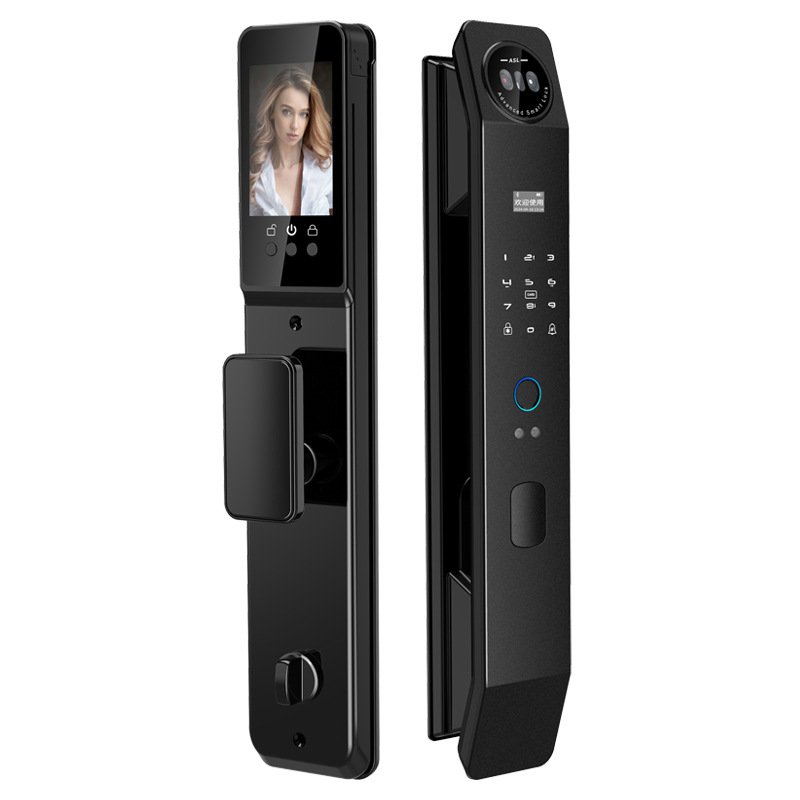
- Accessories inspection: Open the packaging box of the smart door lock and carefully check whether the parts of the door lock are complete, including the lock cylinder, lock body, front and rear panels, square steel, screws, batteries, etc. At the same time, confirm whether the direction of the door lock is consistent with the room to avoid installation errors.
(III) Read the instructions
Smart door locks of different brands and models may have different installation methods and requirements. Therefore, you must read the product instructions carefully before installation to understand the characteristics, installation steps, precautions, etc. of the door lock. If there are any unclear points, you can contact the manufacturer’s customer service or professional installers for consultation.
III. Installation steps
(I) Dismantle the old lock
- Remove the handle: If the door lock is fixed with screws, first unscrew all the screws on the side of the door, remove the lock body, pull out the lock cylinder, and then unscrew the upper and lower screws on the panel behind the door. Pull the front and rear panels apart and the lock can be removed. If the door lock is fixed with rivets, you need to drill the rivets with an electric drill before you can remove it.
- Clean the door: After removing the old lock, clean the residue and dust on the door to ensure that the installation surface is clean and tidy.
(II) Determine the left and right directions of the door and adjust the handle and lock tongue direction
- Determine the direction: Determine the left and right directions of the smart door lock according to the direction of the door. Generally speaking, when a person stands outside the door, the lotus leaf chain is on the left hand side for left opening, and vice versa for right opening; pushing the door into the room is inward opening, and pulling it outward is outward opening.
- Adjust the direction of the handle (applicable to semi-automatic locks, not fully automatic locks): Loosen the screw next to the handle, turn the handle to the appropriate direction, and then tighten the screw. The method of loosening the screws may be different for different locks. Some need to tighten the screws next to the square hole, and some need to reach into the square hole to loosen it.
- Adjust the direction of the lock tongue: Check whether the direction of the lock tongue is consistent with the original lock body. If not, the direction of the lock tongue needs to be adjusted. The adjustment method is generally to pull out the lock tongue and rotate it, or to turn the protruding button of the lock body. The specific operation can be performed according to the different lock bodies.
(III) Install the lock body and lock core
- Install the lock body: Put the lock body into the door opening, screw in the screw holes except the one in the middle (if it is fixed with rivets, use a rivet gun to drive in the newly purchased rivets). If there is a top and bottom hook, hang it up; if not, do not install the top and bottom hook.
- Install the lock core: Insert the lock core into the lock body hole (except for the lower insert), screw in the screw hole in the middle, and lock the lock core. Pay attention to the front and back of the lock core during installation, with the round hole facing the outside of the door and the square hole facing the inside of the door.
(IV) Install the inner and outer lock panels
- Cut the square steel: Cut the square steel according to the thickness of the door. The length of the square steel can be determined by looking at how much the square steel holes of the front and rear panels extend into the door, and then add it to the thickness of the door to get the initial cutting length. If there is still a gap between the front and rear panels after cutting, you can cut a little more. You can use a manual cutter or an electric cutter for cutting. Manual cutters are more laborious, while electric cutters are more convenient.
- Adjust the direction of the square hole clutch: The square hole clutch is a silver-gray component with a square hole in the middle of the back panel. It can be inserted with square steel. Generally, there are triangular arrows and dots on it. The clutch has a very large effect and affects the door opening action. If it is installed incorrectly, the door cannot be closed or the door opens and closes. When adjusting the direction of the square hole clutch, you can refer to the manual. If you don’t understand the manual, you can also try to rotate the clutch to the bottom. If it doesn’t work, rotate it to the other side to the bottom. There is always one side that is correct.
- Install the connecting rod: Install the connecting rod of the front and rear panels, and put on the front and rear panels. When putting them on, align the square steel hole, the lock core hole, and the anti-locking lock tongue. Semi-automatic locks only have front and rear panels, and fully automatic locks also have baffles.
- Fix the panel: After putting on the indoor and outdoor panels, connect the wires and tighten the screws. Be careful not to press the cable during installation to avoid short circuits and other problems.
(V) Install the battery box and connect the power supply
- Install the battery box: Install the battery or connect the power cord according to the type of smart door lock. Install the battery into the battery box, and then install the battery box in the corresponding position.
- Connect the power supply: If it is a smart door lock connected to the power cord, make sure the power connection is firm to avoid safety hazards.
(VI) Cut accessories (if necessary)
Cut the lock core paddles, square rods and other accessories as needed to ensure that they are installed in place. Pay attention to the size when cutting to avoid affecting the normal use of the door lock.
IV. Debugging and testing
(I) Set the unlocking method
After the installation is completed, you must first set the unlocking method such as fingerprint and password. According to the operating steps in the product manual, enter the fingerprint and password of family members into the smart door lock.
(II) Test the unlocking function
- Multiple unlocking method test: Test different unlocking methods multiple times, such as fingerprint unlocking, password unlocking, mechanical key unlocking, etc., to ensure that the switch is normal without jamming or abnormality.
- Test of the ejection and retraction of the lock tongue: Move the handle forward and backward to see if the lock tongue can be ejected. If not, it is likely that the square hole is installed incorrectly and you need to check the direction of the square hole; if it can be, press it down again to see if it can be retracted. If there is no problem with lifting up to lock (to eject the lock tongue) and pressing down to unlock, it means that the unlocking function is normal.
(III) Check other functions
Check other functions of the door lock, such as anti-locking, alarm, etc., to ensure that everything is normal before using. For example, test whether the anti-locking function can be enabled normally and whether the alarm function can sound an alarm in time under abnormal circumstances.
V. Precautions
(I) Precautions during installation
- Non-destructive installation: During the installation process, try to avoid unnecessary cutting and hole expansion to avoid damage to the door body. If you encounter a non-standard lock body, it is recommended to seek professional help to ensure the installation quality and the service life of the door lock.
- Power-off operation: If drilling and other operations are required during the installation process, be sure to turn off the power first to avoid electric shock accidents.
- Avoid damage to equipment: When installing smart door locks, be careful to avoid damage to smart door locks and supporting equipment. For example, do not use excessive force during installation to avoid damaging the lock body, panel and other components.
(II) Precautions after installation
- Regular maintenance: Regularly maintain the smart door lock, such as cleaning the lock body, checking the battery power, etc., to ensure its normal operation. If the battery power is low, replace the battery in time to avoid being unable to unlock due to battery failure.
- Pay attention to safety: Although smart door locks have high security, you should also pay attention to protecting the unlocking information, such as not telling the password to others at will, and avoiding fingerprint information from being copied. At the same time, check the security of the door lock regularly. If any abnormality is found, contact the manufacturer or professional maintenance personnel in time for processing.
VI. Conclusion
The installation of smart door locks is a process that requires carefulness and patience. Through the detailed installation method introduction in this article, I believe that users can master the correct installation steps and precautions. During the installation process, strictly follow the requirements of the instructions to ensure the quality of installation. After the installation is completed, comprehensive debugging and testing should be carried out to ensure that all functions of the smart door lock are normal. Only in this way can the advantages of the smart door lock be fully utilized to provide reliable protection for family safety. At the same time, users should also pay attention to regular maintenance and care during use to extend the service life of the smart door lock.